R N G Do It Again
We all know that difficult work beats talent. But does difficult work beat luck?
A couple of days ago, I was filling out a behavioral cess test every bit part of my internship application, and I came across a very interesting statement: "How much of your success is attributed to your hard work?" The question stunned me for a good 3 minutes as I tried to replay all of my life experiences. In the end, I answered fifty%, a safety merely not quite a definitive respond, to say the least. Upward until this signal, I practice feel like a large portion of my success has been a product of all my blood, sweat, tears, and all-nighters that I pulled. However, the assessment question truly gave me a reality cheque because I at present realized that luck may accept a more significant office than I initially thought in determining where I am today.
Fortunately, I previously discussed the role of randomness or the infamous RNG in video games, which you can bank check out in this article. Now, we can extend our knowledge about in-game probabilities into the real world and answer the meg-dollar question: is success luck or hard work?
Why Many Think "Hard Piece of work = Success"
Today's club has always pushed the notion that successful people are all individuals who have put in the most amount of work. Furthermore, successful people rarely spoke about how lucky they are to be in the position in the first place and instead attributed it to all their hard work. When is the last time you heard a celebrity or millionaire say that they are lucky to be famous? Instead, we are always bombarded with quotes that resemble the notion of hard work beats talent or some sort.
"I never took a day off in my twenties. Non i." – Nib Gates
"What'south the primal to success? The cardinal is, in that location is no key. Exist humble, hungry, and the hardest worker in any room." – Dwayne 'The Rock' Johnson
On the surface, the logic adds upwardly. If y'all put in work, yous are going to be skilled and experienced plenty to proceeds an advantage over your competition. In schoolhouse, if you report more y'all will virtually likely get college grades. When you put more effort into your job, your boss volition probably give you a raise at some point in time.
However, this logic may also be a product of our excessively selfish view of the world, a phenomenon calledegoistic bias. This bias is considered psychologically innate for about of us and explains instances of why we often overestimate the amount of work we contribute to a project or why we feel play a significant office in some past even despite non being the case. Selfish might not be actually the proper term to draw egocentric bias because the phenomenon as well explains why nosotros overly remember embarrassing events compared to others or recollect that we are the primary cause of a trouble. But, I digress, egocentric bias may also be the culprit why we think that our success is due to all of our piece of work and try. Everyone, even myself, will probably get offended if someone pointed out that our success is just a product of circumstance. The notion that our achievements are gifted, not earned, immensely downplays all of the hard work that we put in.
Thus, I practise not reject the philosophy that success is correlated with hard work. After all, laziness volition not bring you anywhere in life. Yet, it is all ignorant to say that luck never played a role in the things we accomplish. It is also naive to think that all unsuccessful people are lazy since they might but exist a byproduct of misfortune. How is this so? Permit's take at the role luck plays in success.
How Luck Plays a Huge Role in Success
One of the infamous uncontrollable factors that largely determine our success in life is our birthplace. For all we know, in that location are many hardworking individuals in poorer countries working dawn to dusk, risking their wellness and well-being every bit they struggle to survive in unfathomable working conditions. If hard piece of work is the barometer of success, and then these people are millionaires, not the businessmen working in sky-high function towers. They work 10 times as hard as the richest individuals in the world, and yet it is virtually impossible for them to become rich simply considering they are built-in in a country with a low Gdp. So are all unsuccessful people lazy? Not always. Are they just unlucky? Nearly probably.

Your parent'south social grade volition too play a huge role in your future success. Being built-in into a lower-class family can potentially hinder access to adequate nutrition, proper education, and all the required elements of building a sustainable career. A more subtle luck cistron is your advent. Your physique, height, or race will open up (or close) different opportunities in your career. Although the Hour department may deny this, looks do matter in the hiring procedure . Winning the genetic lottery or existence good-looking also allows yous to resort to social media as an influencer or exercise modeling gigs on the side.
Y'all might think that the examples above are farthermost outlier cases that do non apply to the full general population. Only what if I tell you that luck affects the success potential of every 1 of the states, rich or poor, beautiful or ugly, tall or short. What if I tell you that the "normal" people in the population might actually have the best chance of becoming successful?
Simulating Luck Factor
Permit's take a look at an amazing newspaper chosen Talent vs Luck: the function of randomness in success and failure. I really recommend checking out the paper for yourself since it is much more readable compared to other scientific papers out there. But if make up one's mind non to, I'll summarize what the paper discusses here. Just note that I volition impaired things downward and use abstractions to make statistical concepts easier to grasp
The newspaper looks to investigate the luck plays a larger role in determining a person'due south success than their raw talent. Even though talent is the variable that is discussed in the newspaper, we could also interpret talent equally "hard work" for our case . The study investigates the function of luck by assigning 1000 agents with dissimilar sets of attributes such as talent, intelligence, and skill. The researchers ensured the attributes are distributed according to the Normal distribution. If y'all don't know or forgot what the Normal distribution is, the following figure might aid:
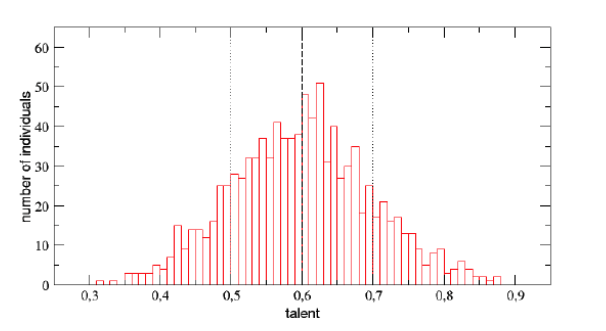
Essentially, most of the agents volition accept a talent score of 0.6, around the middle (too called the mean or average) of the distribution. There might exist some outliers with a talent score of 0.8 and to a higher place; these are the talented or smart kids that you probably green-eyed in school.
These agents are placed in a so-called virtual world to move around and are also given capital letter, which is substantially their coin. Of class, agents with more talent will be able to increment their capital letter at a greater rate, like to what nosotros await in the real world. The researchers and so introduce lucky and unlucky events in the world, which are represented by small green or cherry-red circle blobs. Lucky circles are green, whereas unlucky circles are red.
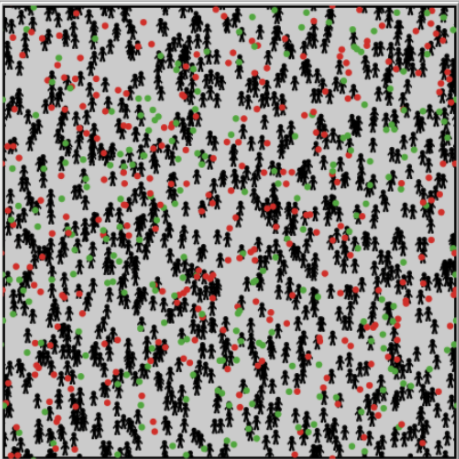
If an agent bumps into a lucky circle, their capital doubles proportionally to his or her talent, similar to how yous might become a big job opportunity in real life for instance. Note how talent still plays a factor in the lucky event. The researchers purposely included this setting in the modeling process since they believe that talent (or hard work in our case) is still necessary for us to capitalize on the lucky opportunity. For instance, y'all might be lucky enough to be offered a position at a company with a high salary. However, if you don't study hard for the interview, then yous will not get the job in the end.
On the other mitt, if an agent bumps into a cerise circle, their capital or success will exist halved. In this scenario, talent plays no office. Unfortunate circumstances like a car accident or a career-ending illness do not depend on talent or hard piece of work.
Well, what is the result of the simulation? Eerily, the results closely resemble the distribution of wealth in the real world, which follows the Power Constabulary. The Power Police force distribution is just some other form of distribution, but with nigh of the population full-bodied on the depression finish of the spectrum instead of the heart.
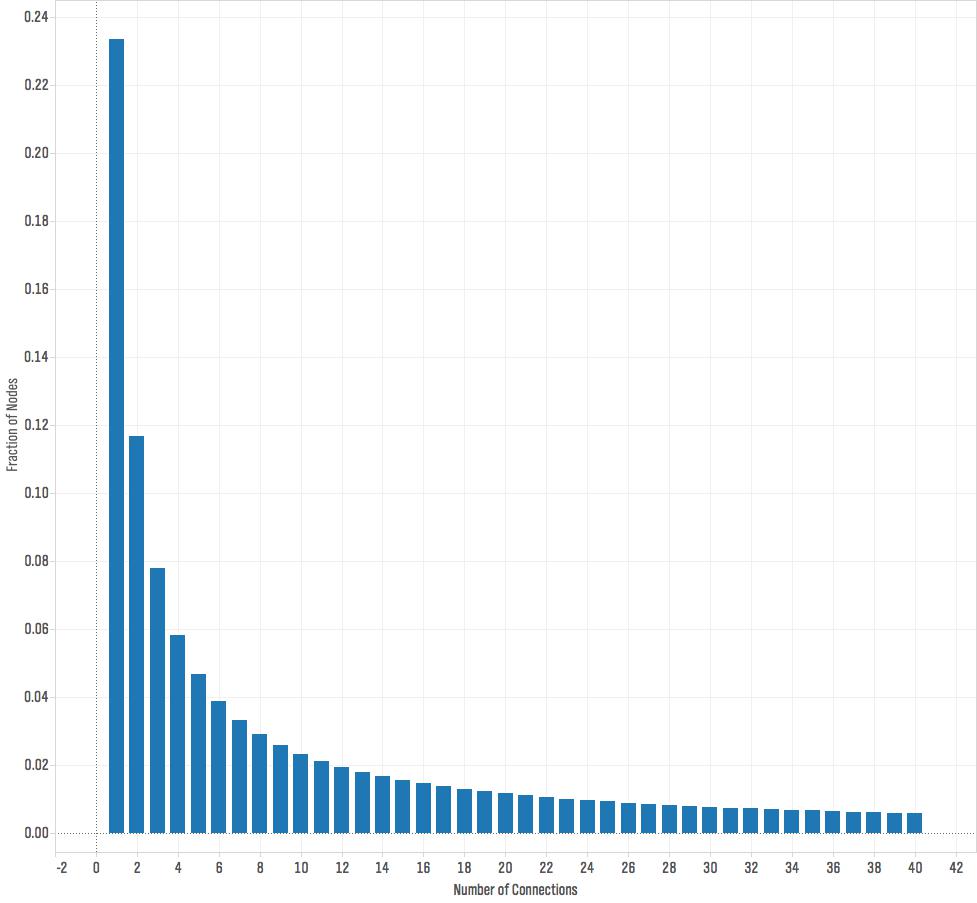
Hither is a comparison of the Power Constabulary distribution compared to the Normal distribution
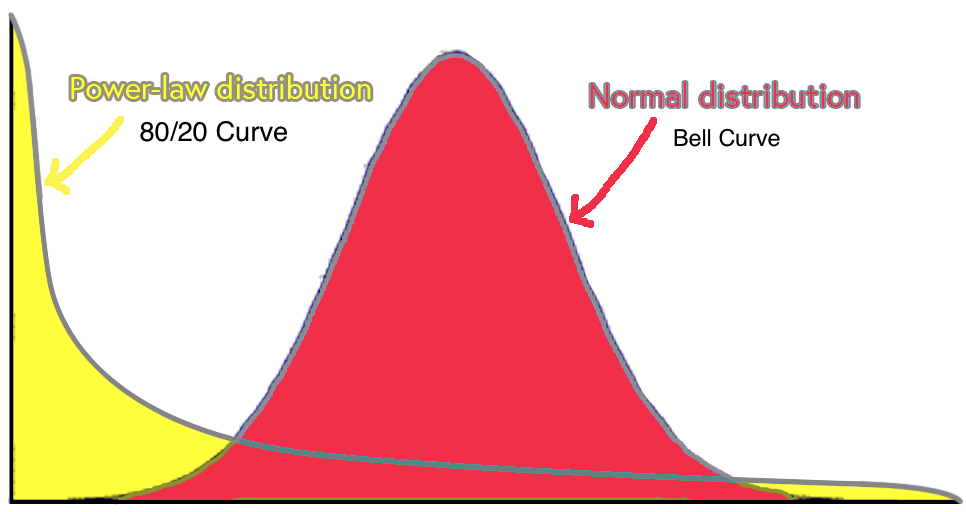
The Ability Law model is often referred to when discussing wealth distribution since there are a lot of poor people and only a handful of billionaires in the globe. In an ideal earth where talent or hard work equals success, nosotros would see a Normal distribution when modeling wealth. However, the discrepancy between the two distributions suggests that in that location is a greater power at play. Is it luck? Well, take a await at the effect of the simulation beneath.
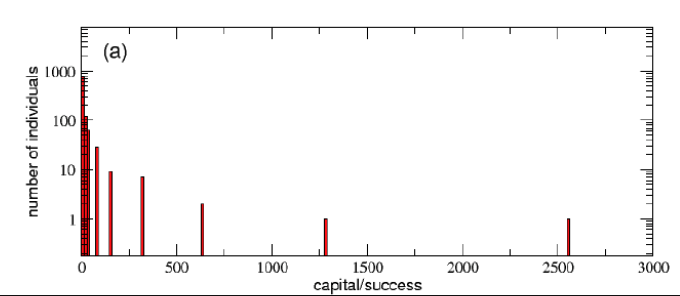
It might not exist obvious at first, just what you are looking at higher up resembles the Power Law; many unsuccessful people and a minor number of extremely successful individuals. Scary, isn't information technology? But, of course, the bigger question is: are the successful people agents talented (hard-working)? Nope . Do y'all run into the amanuensis with the 2600 success score on the right side of the graph? Well, he had a talent score of 0.61, which is but 0.01 greater than the mean talent score value of 0.6. You can see this data more clearly in the graph beneath.
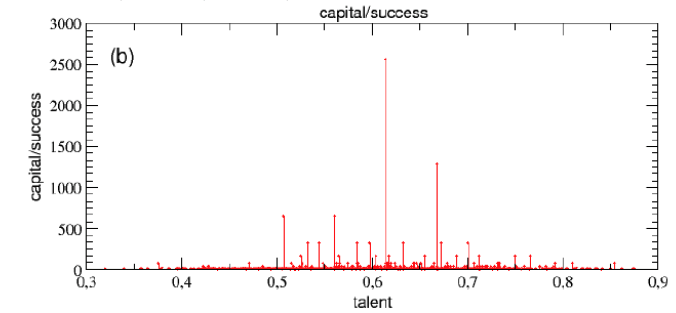
The plot higher up showcases each agent on the talent spectrum (on the x-axis) and their corresponding success score (on the y-axis). The alpine blood-red line you come across in the centre is our lucky man, which again proves that he is just a normal guy with no special talent. On the other hand, take a look at some of the talented agents with a difficult-working mentality on the right side of the plot. The most talented agent, in fact, had a success score of less than one unit (0.625 to be specific), which is miles away from the highest success score or 2600.
The researchers, of course, did multiple simulation runs, but all of them ended with the aforementioned conclusive results. Nearly of the successful agents take mediocre talent or were never really difficult working . Why is this? Since at that place are more than mediocre agents in the normal distribution, in that location is a higher chance for them to bump into the green lucky opportunity and avoid the red unfortunate circumstances. Hence, their success is largely part of their fortune, not talent, not skill, not intelligence, and non difficult work.
Decision
And so, does luck play a role in success? Aye. Should you but stop working and starting time gambling with reality? Definitely not. Remember that the researchers used talent as a coefficient when multiplying the success score on a lucky event. Quoting directly from the paper "the advantage of having great talent is necessary". However, from the results, nosotros also know that talent is "not a sufficient condition to reach a very high degree of success." In other words, success does not solely issue from difficult work alone, insteadinformation technology is a culmination of talent, effort, and some caste of fortune .
But realizing that your hard work may not pay off in the time to come can exist extremely demotivating. You tin can be the hardest working person in the globe, but may never attain success if you never come up across the lucky green circles in your lifetime. So what should you do? Paradoxically, I think it is immensely beneficial to have the hard piece of work = success mentality when you are trying to build your career. Believing you have full control over your future will undoubtedly aid you push to piece of work hard, stay potent and never surrender, which are all the essential ingredients for success. It also helps to remind yourself that laziness almost definitely never equates to success. It doesn't affair how lucky yous are, y'all will never become successful if you will never capitalize on the fortunate opportunities that you are presented in life.
However, once you reached your goal at the superlative, y'all must besides remember that your achievements are, to some extent, also a production of luck. Well-nigh chiefly, don't be the ignorant fool that promotes naive meritocracy – the notion that people'due south progress in life is solely caused by their own accomplishments instead of external factors such as birthplace or your parent'southward social class. Naive meritocracy is also grounded by the belief that everyone is given an equal opportunity in life, which every bit we have established, is completely simulated.
Thus, go on to work hard, and if you haven't worked hard in your unabridged life, starting time doing it now. Who knows, maybe tomorrow y'all'll bump into some fortunate event that will change your life for the better.
Featured paradigm: Unsplash
Source: https://hybrid.co.id/post/rng-in-real-life/
0 Response to "R N G Do It Again"
Post a Comment